













Physics research at SISSA explores Nature at all scales, from the birth of the cosmos and the laws governing matter and energy to quantum systems, biomolecules and living matter. The Area studies the Universe, matter and biological systems through theoretical models, mathematical methods and numerical simulations.
The Area brings together expertise in astrophysics, cosmology, gravitational and particle physics, condensed matter, statistical physics and molecular biophysics, while advancing data science, machine learning and artificial intelligence for the natural sciences. SISSA physicists combine theoretical, computational and interdisciplinary approaches to study complex phenomena and advance fundamental research and innovation.
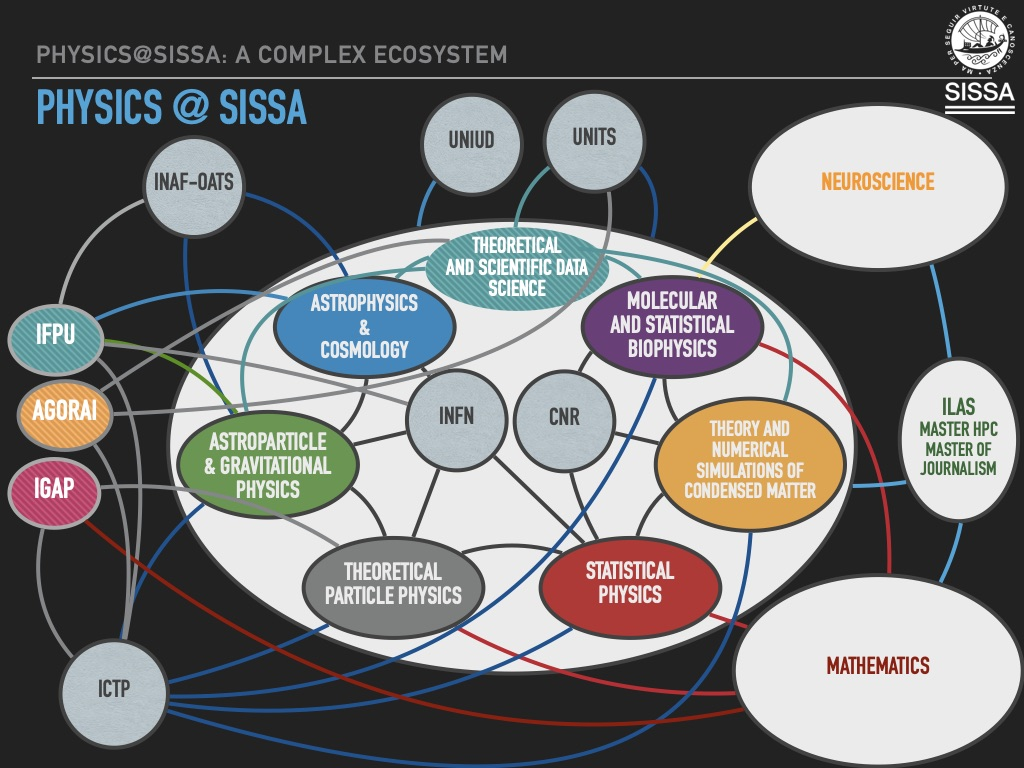
Research in the Physics Area at SISSA focuses on diverse topics, that cover:
- Astroparticle and Gravitational Physics (APG): It is an interdisciplinary field merging astrophysics, cosmology, and particle physics, aims at addressing fundamental issues ranging from origin of the universe and the nature of gravity to the understanding of dark matter and dark energy.
- Astrophysics and Cosmology (APC): Understanding the early universe, cosmic background radiation, dark matter, black holes, and galaxy formation.
- Condensed Matter Physics (CM): Development of methods (Quantum Monte Carlo, Dynamical Mean-Field, Theory, Gutzwiller) to the investigation of a variety of systems spanning the most active research lines of modern solid state, from high-temperature superconductors to nanoscale devices including many other materials, heterostructures and model systems.
- Statistical Physics (SP): Address crucial questions about the nature of phase transitions and foresees the possibility to forge new states of matter, like Bose–Einstein condensation in ultracold gases. It focuses as well on more theoretical directions, like quantum field theory, exactly solved models, random matrices, complex systems, probability, topological quantum computation.
- Molecular and Statistical Biophysics (MSB): Development and application of theoretical and computational approaches to characterize the properties of biomolecular systems. Most of the research activity is devoted to characterize the kinetics, thermodynamics and mechanics of proteins and nucleic acids and to seek quantitative comparison with experimental data.
- Theoretical Particle Physics (TPP): Its aim is to study and develop theories and models devoted to the understanding and unification of the four fundamental interactions in Nature. The main research lines, at present, are: Physics within and Beyond the Standard Model, Neutrino physics, String Theory, the AdS/CFT correspondence, Supersymmetric field theories as well as alternative quantum theories of Gravity.
- Theoretical and Scientific Data Science (TSDS): Study of machine learning problems and their application to natural sciences, combined with a strong interest in public engagement and experience in effective and impactful knowledge transfer. Highly multi-disciplinary with problems that span from astrophysics to system biology.